News Item
now browsing by category
National Register Nomination for Delaware Town in Missouri

We are pleased to announce that we will soon be nominating the Delaware Town site (23CN1), located near Springfield, Missouri, to the National Register of Historic Places. You may remember from earlier issues of this newspaper that the Tribe has collaborated with archaeologists from Missouri State University to further more than ten years of excavations and surveys of the area. The information gained from excavations at Delaware Town will significantly contribute to our understanding of our Delaware and national heritage, as it represents the only archaeological excavation of a residence associated with the Delaware occupation in the Missouri Ozarks. This site is situated within the historical context of the early movements of the Delaware and other Eastern Woodland tribes to regions west of the Mississippi River in order to continue their traditional lifeways away from the bloodshed and missionary efforts that were increasingly present on the Ohio Valley and Great Lakes frontiers following the American Revolution.
According to the historical literature, some Delaware groups first began moving into the Ozarks, along with other groups of their Shawnee, Kickapoo, Piankashaw and Peoria allies, in the 1780s. They first established villages in the eastern Missouri Ozarks. These Delaware and Algonquin immigrants were slowly pressured to points further west as American encroachment and harassment substantially increased west of the Mississippi following the Louisiana Purchase and the War of 1812. As these allied groups moved into the western Missouri Ozarks, the so-called main body of Delaware who had remained along the White River in Indiana agreed to the Treaty of St. Mary’s, 1818, in which they ceded all land in Indiana in exchange for “a country to reside in, on the west side of the Mississippi.” Then-Missouri territorial governor William Clark assigned the Delaware lands in southwest Missouri on the eastern border of the Osage Reservation. It was at the Delaware Town site that the Indiana Delaware and the Ozark Delaware coalesced in a linear riverine village along the James River from 1820 to 1822, and remained there until leaving for their Kansas reservation in 1830. During these years, Delaware Chief William Anderson, who had risen to prominence amidst the nativistic revivals in the Indiana villages, was looked to as the principal spokesperson for the newly-coalesced James River Delaware. Anderson also provided leadership for the neighboring Shawnee, Kickapoo, Piankashaw, and Peoria villagers who settled in and near the Delaware reservation and subordinated themselves to them, whom they still considered as their “Grandfathers.”
The Delaware Town site is the archaeological remains of what was once a residence associated with this last Delaware and multi-tribal settlement present along the James River from 1821 to 1830. Delaware Town can thus significantly contribute to our understanding of this important but underrepresented time period in American history. Current information about this time period is based largely on the archival record and historical publications that have interpreted such collections. I am not aware of any archaeological interpretations that have been produced based on the material culture from these Eastern Woodland settlements beyond the survey reports and conference papers that have come from research on the Delaware Town site. Although the Delaware Town site and others like are known and documented, their presence and significance may be underrepresented in the historical and archaeological record due to the often transient nature of these sites (often occupied for a decade or less) and their close similarity in material culture with other, non-Indian, historic-period frontier settlements. Documenting and preserving the Delaware Town site and emphasizing its veiled uniqueness, can thus significantly contribute to our knowledge of the Ozark region’s history. It is the only site of which I am aware that has yielded both archaeological evidence of the experience of Delawares and allied Algonquins in the Ozark region.
The value of this work to the Tribe is that it helps preserve this important component of Delaware history. Archaeological sites are destroyed every day when they are not actively protected. Once successfully added to the National Register of Historic Places, the Delaware Town Site would enjoy further protections under federal law from potential development that is currently threatening the integrity of the site. Who knows what we will learn from this site if it is preserved for the future?
49th Annual Delaware Powwow, May 24-26, 2013
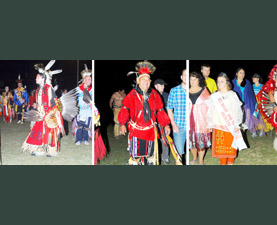
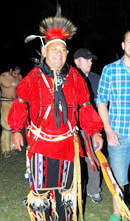
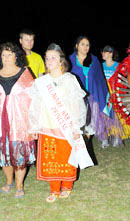
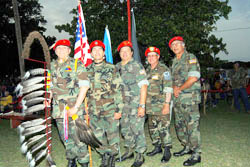
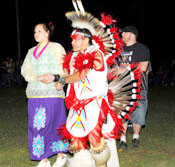
The 49th annual Delaware Powwow was held May 24-26, 2013 at the Falleaf Powwow Grounds near Copan, OK. We hope you all had a good time and will return next year for the historic 50th Annual Powwow!
 |
 |
 |
 |
 |
 |
 |
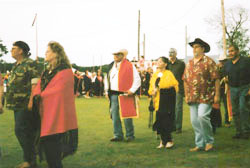 |
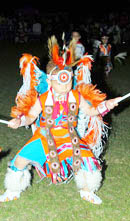
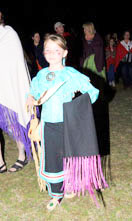
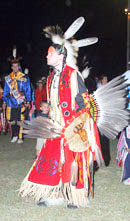
| Top row, l-r: Orange Fancy Dance featuring Jake Lawhead; tribal member Anna Pechonick; tribal member Bear Thompkins; tribal member Bucky Buck; Delaware War Mothers Princess Hayden Griffith. Bottom row, l-r: Delaware Color Guard; Kara House and Vincent Jackson leading the two-step; Grand Entry with Bruce Martin, Chief Pechonick, Jimmie Johnson. |
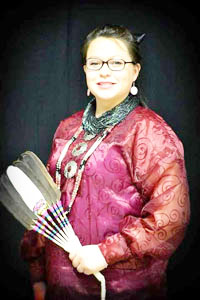 |
| 2013 Powwow Princess Dava Daylight. |
Dedication of the Social Services Building, May 22, 2013
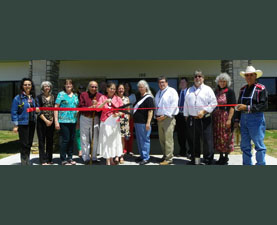
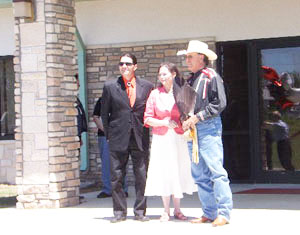
On Wednesday, May 22, the Delaware Tribe of Indians proudly officially opened its new Social Services Building at 166 NE Barbara on the Tribe’s Bartlesville campus. Former chief Dee Ketchum performed the smoke-off ceremony, after which Chief Pechonick and the other members of the Tribal Council were joined by Bartlesville Chamber of Commerce officials for the ribbon-cutting.
We invite tribal members and others to visit this new facility, which includes our Housing, Social Services, Education, and Environmental Programs as well as the Library, Museum, and Archives.
We also want to acknowledge our new Memorial Garden north of the pond across the street from the Social Services building. Thanks to tribal employee Gina Roth and her son Trey for their hard work getting it set up.
 |
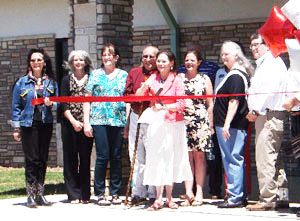 |
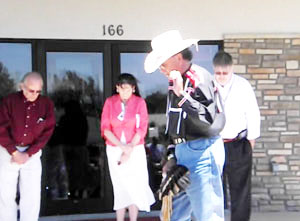
| Former chief Dee Ketchum burns cedar and offers a prayer at the dedication. | Chief Pechonick cuts the ribbon. |
 |
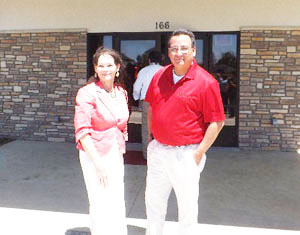 |
| Tribal Manager Curtis Zunigha, Chief Paula Pechonick, and former chief Dee Ketchum after the ribbon cutting. | Chief Paula Pechonick and Jim Gray. |
 |
 |
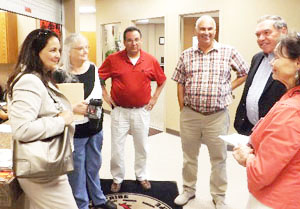
| Chief Pechonick with representatives from Cherokee Nation. | Councilwoman Janifer Brown gives Lee Keener and Jack Baker of Cherokee Nation a tour of the new kitchen. |
 |
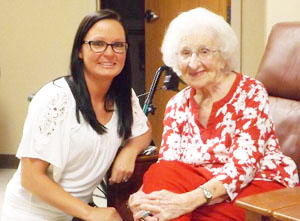 |
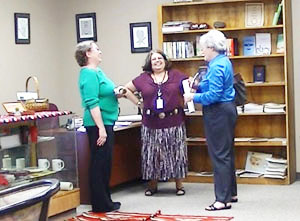
| Tribal Archivist Anita Mathis with Debbie Neece and Joan Singleton of the Bartlesville History Museum. | Coke Meyers, a relative of Will Rogers and the oldest member of the Washington County Historical Society, with its youngest member, Social Services Manager Lacey Harris. |
 |
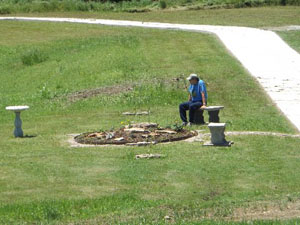 |
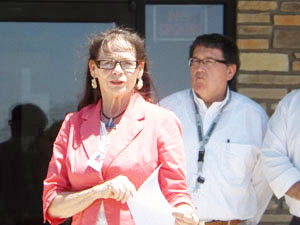
| Chief Pechonick addresses the crowd. | Tribal elder Jack Tatum enjoys the new Memorial Garden. |
Mint Reveals Delaware-Based Design for 2013 Native American Dollar
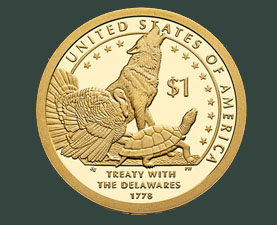
United States Mint officials revealed Nov. 20 the approved design for the 2013 Native American dollar.
The adopted design features a turkey, howling wolf and turtle—all symbols of the clans of the Delaware Tribe—and a ring of 13 stars to represent the original Colonies. It was sketched by U.S. Mint Artistic Infusion Program Master Designer Susan Gamble and sculptured by U.S. Mint Medallic Sculptor Phebe Hemphill.
The design was approved Oct. 16 by Deputy Treasury Secretary Neal S. Wolin on behalf of Treasury Secretary Timothy F. Geithner. It was selected from 13 reviewed by the Citizens Coinage Advisory Committee and Commission of Fine Arts. The approval process included input in summer and autumn from representatives of the governments of the three federally-recognized Delaware tribes—the Delaware Tribe of Indians; Delaware Nation in Anadarko, OK; and the Stockbridge Munsee Community of Bowler, WI.
It’s the first Indian dollar coin since the Sacajawea in 2000, and is only available in collector proofs and sold through the mint. The Delaware Tribe signed the first Indian treaty with the U.S. at Fort Pitt and approved by Congress on September 17, 1778.
http://www.coinworld.com/articles/printarticle/mint-reveals-design-for-native-american-coin
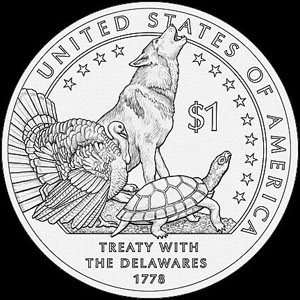
To order coins, go to http://catalog.usmint.gov/webapp/wcs/stores/servlet/CategoryDisplay?langId=-1&storeId=10001&catalogId=10001&identifier=3000.
Delaware Tribe Adopts New Tribal Seal
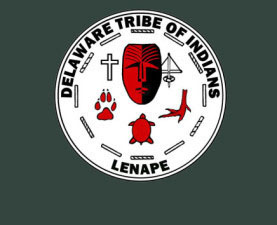
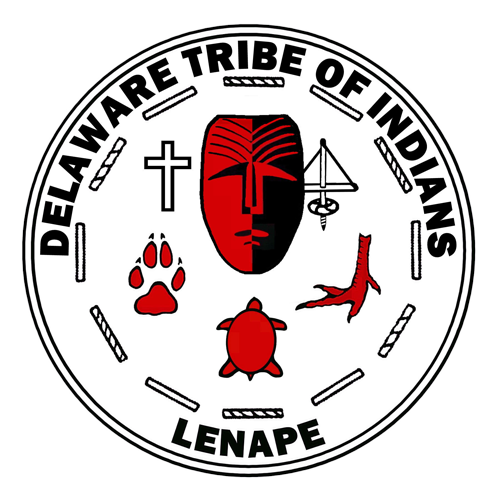
After over 40 years, the Delaware Tribe has adopted a new version of the official tribal seal. The changes to the artwork and lettering were developed in collaboration with tribal community members. It was approved by a resolution of the Tribal Council on January 7, 2013.
Look for the new seal on tribal flags, stationery, official documents, and tribal vehicles.
About the Seal
Colors: Red and black are the main colors used by the Lenape. These are on a white background.
Mesingw Face: The Mesingw face in the center of the seal is the Keeper of the Game Animals on which the Lenape depended for food. The face was carved on the center post of the Big House Church (“Xingwekaown”), a wooden structure which held the tribe’s historic religious ceremony (though no longer practiced).
Clan Symbols: These represent the three clans of the Lenape: Turtle, Wolf and Turkey.
Fire Drill: The Fire Drill next to the Mesingw face is used to build ceremonial fires.
Prayer Sticks: These are around the outer edge of the seal and represent the twelve prayer sticks that were used in the Big House Church.
Cross: There is also a Christian cross to represent those Lenape who accepted Christianity. Some of the Lenape people had converted to Christianity as early as the 17th Century.
The Old Seal (Tribal seal, 1970 to 2012)
The seal-revision project was started in mid-2012 in consultation with members of the Culture Preservation Committee and Elders Committee. Revisions included removal of the words “Seal of the” and replacement with the tribe’s official name; replacement of “Lenni Lenape” with the more common term “Lenape,” which means “The People”; and replacement of the Mesingw face, the wolf paw print, turkey talon, and turtle symbols with more accurate artistic representations. The plains-style “peace” pipe was removed as it wasn’t an actual part of the ritual instruments of the Big House Church ceremony. The Christian cross was changed to white with black border so as not to be confused with the Red Cross organization.
Old Seal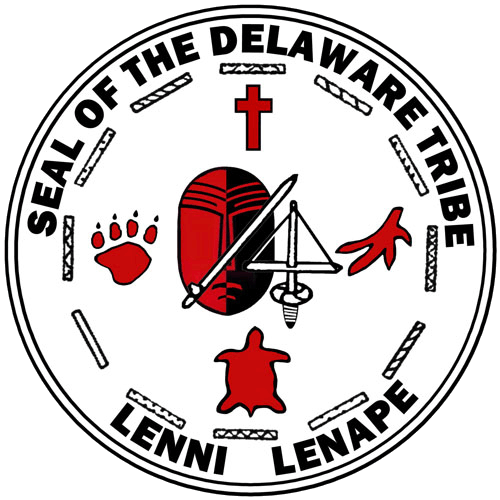 |
New Seal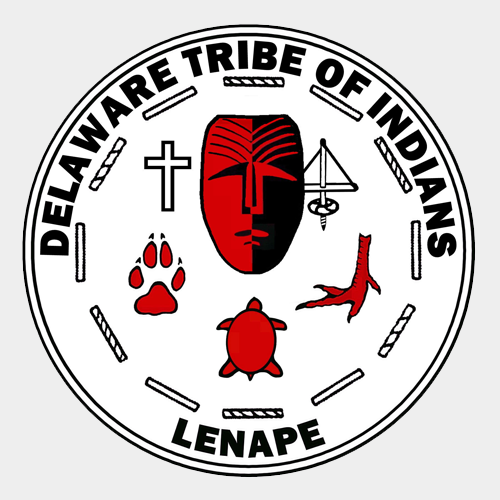 |
Seal is copyrighted by the Delaware Tribe of Indians. All rights reserved.
 D5 Creation