News Item
now browsing by category
Ethnobotanist Visits Tribal Headquarters

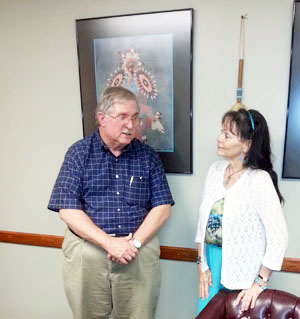
George Hill, who in 1972 wrote a paper Delaware Indian use of plants, published in Oklahoma Anthropological Newsletter (March 1972), visits with Chief Paula Pechonick.
The 50th Annual Delaware Pow Wow, by Mary Watters

War Mothers Entry – When they came in, I was particularly proud of our Granddaughter, Jennifer Revard. She came in and I’m sure you noticed her headdress. Her Aunt made this for her because she doesn’t have any hair yet. She’s been through a very bad year of breast cancer and so her hair hasn’t completely started to grow back in yet. She wanted to dance and she wanted to wear her traditional dress, “so you know I can’t dance without something on my head” and our ansipelaona doesn’t cover all your hair, just the back. So anyway Laura did some research and she found a picture of Susan Elkhair in some of the papers of the history of the Delaware. Laura ordered a hat, a top hat, and bought a little sheet of metal. She got some creepers to cut the metal. She fixed a band around this hat. She got feathers to go around the band. A friend helped with the feathers that decorated this hat. And this hat is what Jennifer wore. It created a stir because this had not been seen in years and years. She was very proud to wear it and represent the Elder Delaware. That night afterwards, Mike Pace, whose mother was from the Elkhair family, presented Jennifer with a broach that had belonged to Susan Elkhair and had been passed down through generations to him. He ended up with it and he gave it to Jennifer. So it was really an emotional and happy time because she told us all “Thank You” for this past year what she’s been through and what her friends and family and relatives have helped her and she said “it’s over and I won”! And this was really a special moment for me and this moment that we had our honor dance as Gilbert and I were picked as “Honor Elders” and we were led in by our grandsons, great grandsons and grandsons- in- law. They reached across the arena in front of us as we came in and then we had about, I can’t remember how many came and shook hands with us and how they made us feel completely honored. It was one of the most special moments in our lives and we appreciate everybody that was there and everybody that came and shook hands with us. It was a wonderful, wonderful Pow Wow to me.
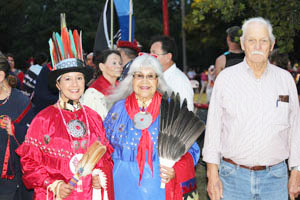 Jennifer Revard with her headdress, flanked by Mary and Gilbert Watters. |
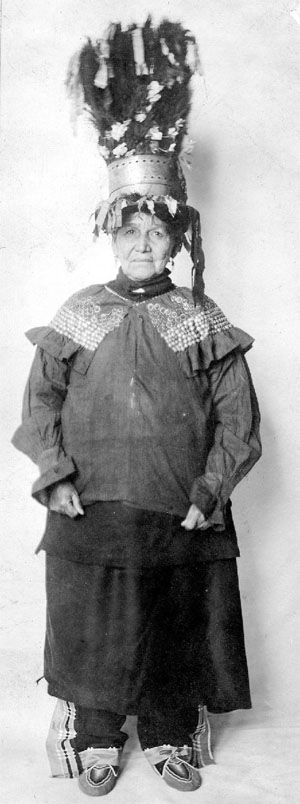 Susan Elkhair wearing the original headdress. |
Thoughts on the 50th Annual Delaware Powwow

By Bear Tompkins, Head-Man Dancer
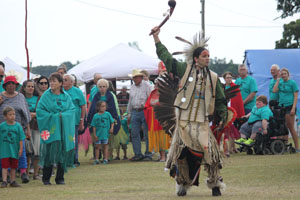
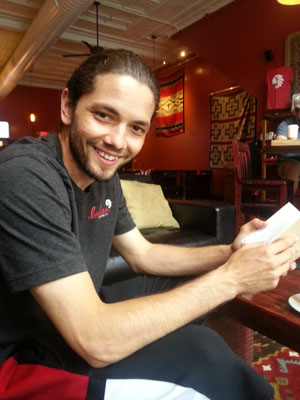 My name is Bear Tompkins, I am a member of the Delaware tribe, and I was the head-man dancer at the Delaware powwow. This year was the 50th annual Delaware powwow. It was a very memorable powwow and a very big honor for my family and me. We were honored when the powwow committee asked me to be this year’s head-man dancer. My parents Ray and Sandy Tompkins pre- pared for an entire year, getting everything ready for my special, and my mom spent a considerable amount of time on my regalia (outfit). I am very thankful for them and all the support they gave me through this. My grandparents Walt and Pat Donnell have always worked hard every year to prepare our camp for the upcoming year. My grandmother has always helped with my regalia and she made me a brand new shirt and vest for this year’s powwow. My uncle Doug sang his song for my special. I remember last year when I was asked to be head-man, I went to my uncle right away and asked him to sing a song for me. He said he would and he did not disappoint. The song he sang was composed for him and it was such an honor for him to sing it for my special. My great uncle Dee Ketchum spoke for me at my special. All of my family was there this year to support me, of course, they are there every year. But they showed me how much they care and how much they love me by all pitching in and helping out with the process. I could not have done anything without them. I am truly blessed to have such a wonderful family.
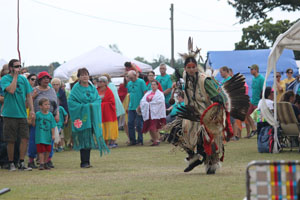
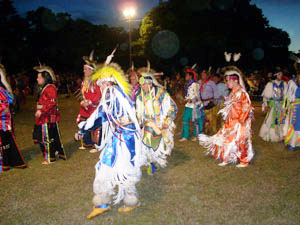
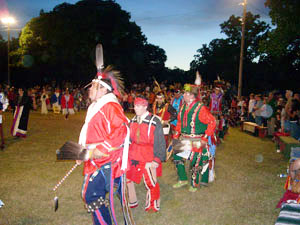
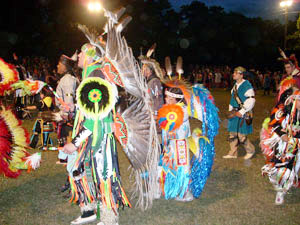
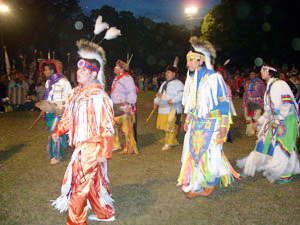
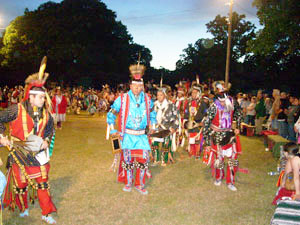
The powwow this year was great! Thursday night, the Culture Preservation, had their night out at the powwow grounds. The turnout was really big and a lot of young kids and children were stomp dancing around the fire and dancing to our Lenape social dance songs. Friday and Saturday night the powwow was in full effect. The dancers were looking keen in their regalia and the drum sounded sweet! All of the Delaware families were camping out all weekend and the fires were kept burning all night. Some even got in a little trouble for being a little too rowdy! But that’s just kids being kids. Everyone seemed to enjoy themselves and that’s what it is all about. We all had a great time even if Sunday night was rained out. The 50th annual Delaware powwow was certainly one to be remembered. May God bless us all. Wanishi!
 |
 |
Culture Night at the 50th Annual Delaware Powwow
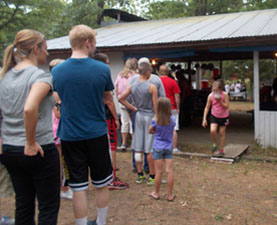
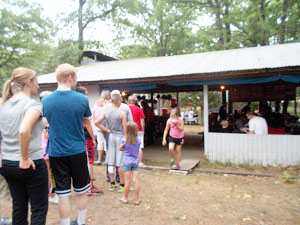
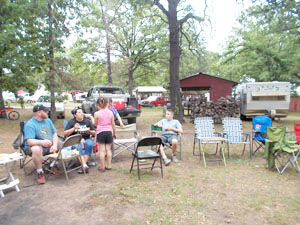
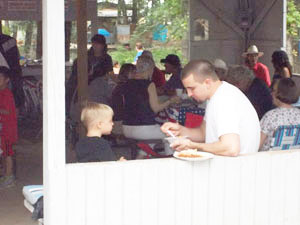
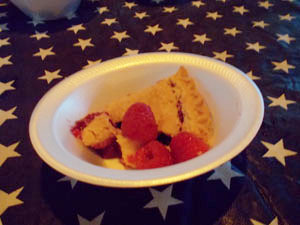
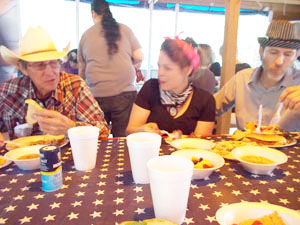
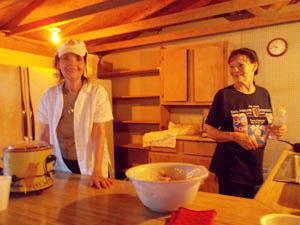
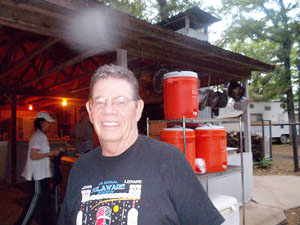
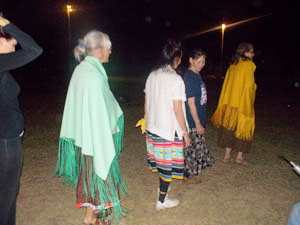
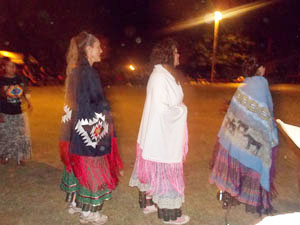
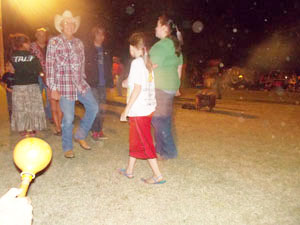
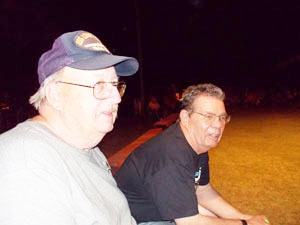
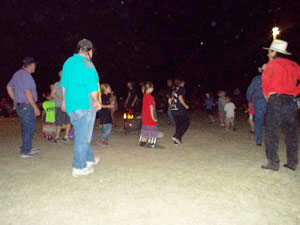
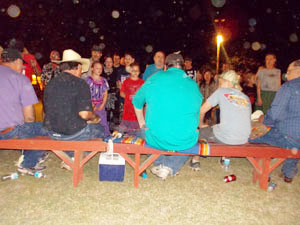
Culture Night at the 50th Annual Delaware Powwow, sponsored by the Cultural Preservation Committee. Potluck dinner in the arbor at the Ford Griggs campsite, Thursday, May 22.
Be sure to come join the fun at the Powwow, May 23-25. DETAILS HERE.
Photos by Roseanne McKee.
 |
 |
 |
 |
 |
 |
 |
 |
 |
 |
 |
 |
 |
 |
Film Explores Delaware Tribe’s History in Indiana
By: Roseanne McKee
On April 12, 2014, Ball State University in Muncie, Indiana, held a special showing of a new documentary about the Delaware Tribe of Indians, for the period in which they made Indiana their home.
The award-winning documentary, prepared by Communications Department students, through filmed re-enactments and interviews, chronicles the forced migration of the Delaware Tribe from their original home in the region now known as southern New York, New Jersey and Delaware through: Pennsylvania, Ohio, Indiana, Missouri, Kansas and present-day Oklahoma.
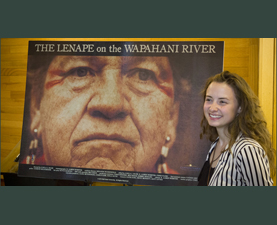
This 30-minute documentary, entitled Lenape on the Wapahani, explores the historical record of the Delaware Tribe establishing a village near Muncie, Indiana, where Ball State University is located, and the reasons for the Delaware Tribe’s arrival and departure from Indiana.
The group that made the trip to Indiana for the April 12 showing were: Chief of the Delaware Tribe, Paula Pechonick, Tribal Archivist, Anita Davis Mathis and Tribal Manager, Curtis Zunigha. They travelled to Ball State University for the showing and to visit previous village sites along the Wapahani, or White River, in Indiana. Wapahani is the Delaware’s name for the White River. A group of ten Delaware living in Indiana also responded to the invitation for the showing, Mathis said.
“The documentary reconstructs our Indiana history. In 1795 the Greenville Treaty took our ancestors to Indiana and the St. Mary’s Treaty took us out in 1818,” Mathis said.
“The Delaware set up a series of villages starting just below present day Muncie to about the Marion County line above Indianapolis,” Conner Prairie Interactive History Park Historian Tim Crumrin said in the documentary. “There were as many as 12 to 14 villages. There were permanent and seasonal ones,” Crumrin said. “Six stood the test of time. The others were either trading post villages or temporary villages they would set up.”
Mathis said that during the visit to Indiana in April, “they took us to a park where our own village was – where two rivers meet – the White and the Buck River, Tribal Archivist, Anita Mathis, said in an interview May 5. One thing that struck her was that “where the rivers met, there were two different colors,” Mathis said.
During the visit, Zunigha offered a prayer, Mathis said. “He took from his cedar chest and offered tobacco at the site. This is a gift to the land and the spirits. He threw it on the ground facing the east and prayed and then offered some to the water. His prayers were said in English and in Delaware.”
Mathis said she was grateful that Ball State University had provided her with raw interview footage and information to add to the Delaware Tribe’s archives with details about this period. “In 1751 the Delaware moved to Eastern Ohio and in 1795 they moved to Indiana,” Mathis said.
Mathis said that she had learned that her ancestors had “lived very simply. It wasn’t uncommon at all for the eldest to be raised by the grandparents. Normally the first born would be raised by the grandparents and then in turn take care of the grandparents.”
In the documentary Crumrin called the Delaware “possibly the most oft moved group in American history.”
The Europeans first encountered the Delaware in the 1560’s according to Historian Mike Pace, who is Delaware, of the Conner Prairie Interactive History Park. A clash of cultures resulted. “The Europeans believed in amassing wealth and in ownership of land,” Pace explained.
“The tribes here believed not in the ownership of land. The land was for everybody to share in. We did not have a reason to amass wealth…” Pace said. Nonetheless, over time the Delaware were again moved and agreed to accept land in Kansas territory.
“We were the first tribe to sign a treaty with the new U.S. government in 1778,” Mathis said.
“The Delaware moving from their original homeland back East, those moves were precipitated by agreements with European countries or the new United States of America through treaties,” Curtis Zunigha said in the documentary.
After leaving Indiana, the Delaware stopped in Missouri, before settling in Kansas for a time, Mathis said.
“When they left Indiana they came to Missouri, by Springfield for a couple of years and then went into Kansas where they had over two million acres – Kansas City, Leavenworth, Lawrence, Kansas. By 1835 they were all in Kansas, where they stayed until 1867,” Mathis said.
“We got paid in Kansas for our lands and paid the Cherokee for what is now Washington County, [Oklahoma],” she added.
According to the text of the document provided by Mathis, on April 8, 1867, the Delaware signed a Memorandum of Agreement with the Cherokee to pay $1.00 per acre for 160 acres for each man, woman, and child of the Delaware Tribe “for the use of the lands by which to preserve their tribal organization and laws for a total sum of $157,600. In addition, the Delaware paid the sum of $121,824.28 to the Cherokee as a proportional amount of the Cherokee National fund determined by the number of Delawares as compared to the whole number of Cherokee.”
The Cherokee Nation viewed this payment for lands as a lease rather than a land purchase, Mathis explained. Unable to persuade the Bureau of Indian Affairs otherwise, the Delaware Tribe had no reservation as a result.
“We’re a landless tribe except for the land we now have — seven acres in Caney and then the 93 acres in Lawrence, [Kansas]. Some of which is on the original reservation,” Mathis said.
The documentary described the Delaware Tribe as “a persistent people.” With a long history of forced migration, the Delaware, nonetheless, retained their tribal identity.
“Many other tribes did not survive or they’ve had to be absorbed by other tribes to survive. That persistence is because we have an obligation to keep our identity, our language, our culture and tribal identity because it is a gift from the Creator,” Zunigha said in the documentary.
“Wherever they moved, they began to have a relationship with the river, the water that gave them life and sustenance,” Zunigha explained.
In the documentary the Delaware are referred to as Lenape. The Delaware name began being used to describe the Lenape because of their location near the Delaware River, which was named after Lord Dela Warr, Crumrin explained.
“The original land of the Lenape, that ties to all of our creation legends, the first memory of who we are as a people originated in that river valley and all the way to the Atlantic Ocean. Our creation legend says that a great turtle rose from the ocean to create Turtle Island – the North American continent,” Zunigha said.
Mathis is pleased a portion of the Kansas acreage purchased is on land that was part of the Delaware Tribe’s Kansas reservation. The land will provide a base operation in Kansas to provide services to members of the Delaware Tribe and to advance the preservation of their language, culture and lifeways.
Perhaps most important, the purchase of the 93 acres in Kansas by the Delaware Tribe provides a fresh opportunity for something that the Delaware have not had since they left their original home – a place to call their own.
The documentary may be viewed at www.lenapeonthewapahani.org.
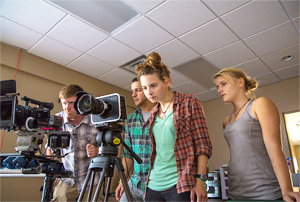 Gaffer Andrew Bultemeier, Cinematographer R. Aaron Webster, Director Kayla Eiler, and 1st Asst Camera Kathie Green prepare for interviews on Bartlesville campus. Gaffer Andrew Bultemeier, Cinematographer R. Aaron Webster, Director Kayla Eiler, and 1st Asst Camera Kathie Green prepare for interviews on Bartlesville campus. |
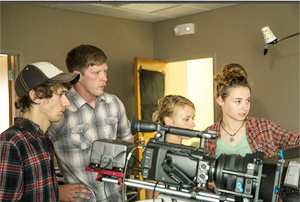 Field Audio Specialist Ben Kruis, Gaffer Andrew Bultemeier, 1st Asst Camera Kathie Green, and Director Kayla Eiler. Field Audio Specialist Ben Kruis, Gaffer Andrew Bultemeier, 1st Asst Camera Kathie Green, and Director Kayla Eiler. |
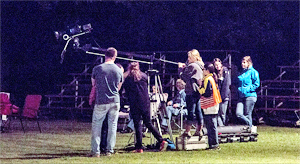 Crew films during Delaware Days, September 2013. Crew films during Delaware Days, September 2013. |
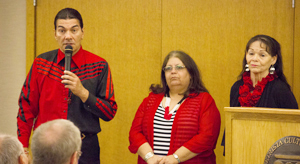 Curtis Zunigha, Director of Cultural Resources Anita Mathis, and Chief Paula Pechonick answer questions at premiere showing at Ball State University, April 2014. Curtis Zunigha, Director of Cultural Resources Anita Mathis, and Chief Paula Pechonick answer questions at premiere showing at Ball State University, April 2014. |
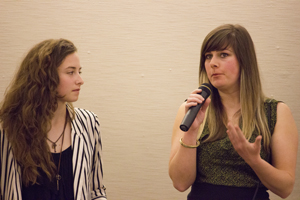 Executive Director Alina Beteringhe answers questions with Kayla Eiler. Executive Director Alina Beteringhe answers questions with Kayla Eiler. |
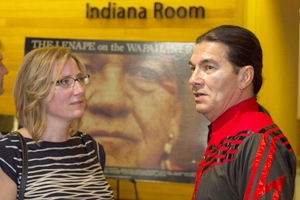 Executive Producer Kelli Huth talks with Tribal Manager Curtis Zunigha. Executive Producer Kelli Huth talks with Tribal Manager Curtis Zunigha. |
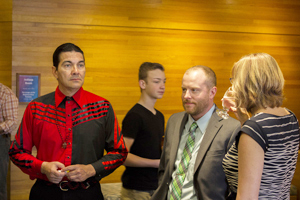 Curtis Zunigha with executive producers Chris Flook and Kelli Huth. Curtis Zunigha with executive producers Chris Flook and Kelli Huth. |
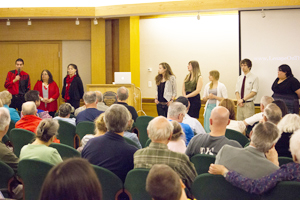 Filmmakers (right) and tribal officials answer questions at the premiere at Ball State University. Filmmakers (right) and tribal officials answer questions at the premiere at Ball State University. |
Delaware Tribe of Indians Online Gift Shop Open for Business!
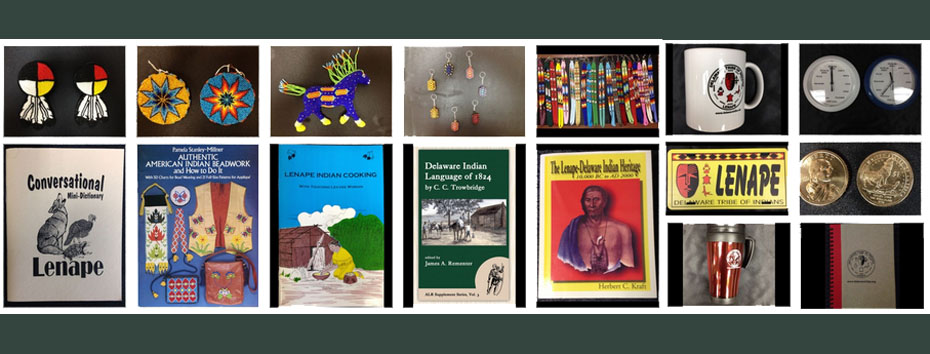
We are excited to announce that the online gift shop for the Delaware Tribe of Indians is now up and running! The same outstanding collection of Delaware merchandise available at the Tribal Headquarters in Bartlesville is now available for those of us who want to show off our Lenape heritage, but are unable to make it out to Oklahoma. We have everything from pocket Lenape dictionaries, to apparel featuring the official tribal seal, to beadwork, to books about Delaware history, and much, much more! We offer shipping throughout the United States as well as free in-person pickup in Bartlesville. We are also offering the option to pick up orders for free at the annual Pow-Wow each year in the Bartlesville area on Memorial Day weekend. All proceeds go towards expanding and improving the Cultural Resources Department of the Delaware Tribe of Indians as we work towards our ultimate goal of creating a museum for Delaware culture and history.
You can find the online gift shop at https://www.delawaretribe.org/shop or by clicking on the Gift Shop button at the bottom of the Delaware Tribe of Indians home page at https://www.delawaretribe.org. Check back often as we will be adding some exciting new products over the next few months.
All online payments are processed through PayPal. PayPal registration is free and available at http://www.paypal.com, or you can use a credit or debit card.
Everything available online is also available at the Gift Shop located in the Social Services building at the Tribal Headquarters at 170 NE Barbara, Bartlesville, OK 74006. Visitors to the Gift Shop will be able to explore the Tribal Archives, as well as have first access to new products as they are added to the online store. The Gift Shop in Bartlesville accepts cash, checks, and most major credit/debit cards. The Gift Shop hours are 9:00 AM–5:00 PM Monday–Thursday and 10:00 AM–2:00 PM on Friday.
Questions, comments, and suggestions are welcome! You can reach us at shop@delawaretribe.org. If you are a Delaware artisan, who wishes to have your products sold through the Delaware Gift Shop, contact Anita Mathis at amathis@delawaretribe.org.
Message from the Tribal Council
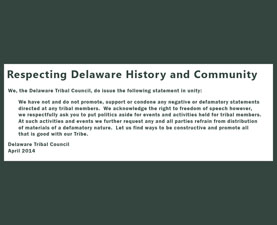
Respecting Delaware History and Community
We, the Delaware Tribal Council, do issue the following statement in unity:
We have not and do not promote, support or condone any negative or defamatory statements directed at any tribal members. We acknowledge the right to freedom of speech however, we respectfully ask you to put politics aside for events and activities held for tribal members. At such activities and events we further request any and all parties refrain from distribution of materials of a defamatory nature. Let us find ways to be constructive and promote all that is good with our Tribe.
Delaware Tribal Council
April 2014
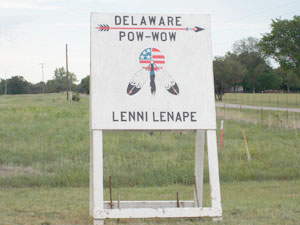
50th Annual Delaware Powwow, May 23-25, 2014
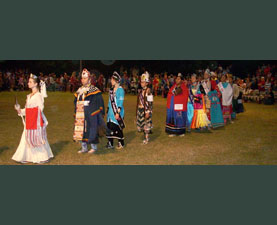
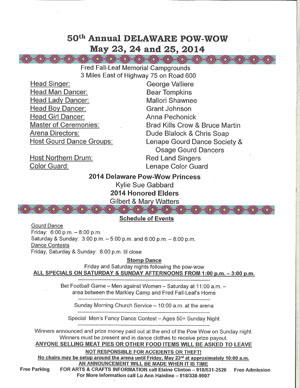
Fred Fall-Leaf Memorial Campgrounds
3 Miles East of Highway 75 on Road 600
Head Singer: George Valliere
Head Man Dancer: Bear Tompkins
Head Lady Dancer: Mallori Shawnee
Head Boy Dancer: Grant Johnson
Head Girl Dancer: Anna Pechonick
Master of Ceremonies: Brad Kills Crow and Bruce Martin
Arena Directors: Dude Blalock and Chris Soap
Host Gourd Dance Groups: Lenape Gourd Dance Society and Osage Gourd Dancers
Host Northern Drum: Red Land Singers
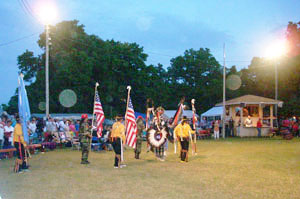
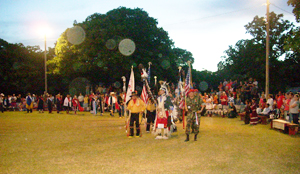
Color Guard: Lenape Color Guard
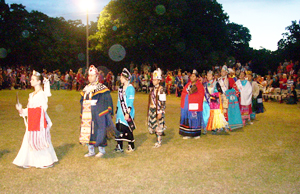
2014 Delaware Pow-Wow Princess: Kylie Sue Gabbard
2014 Honored Elders: Gilbert and Mary Watters
Schedule of Events
Gourd Dance
Friday: 6:00p.m.–8:00p.m.
Saturday & Sunday: 3:00p.m.–5:00p.m. and 6:00p.m.–8:00p.m.
Dance Contests
Friday, Saturday & Sunday: 8:00p.m. til close
Stomp Dance
Friday and Saturday nights following the pow-wow
ALL SPECIALS ON SATURDAY & SUNDAY AFTERNOONS FROM 1 :00 p.m.–3:00 p.m.
Bet Football Game—Men against Women—Saturday at 11:00 a.m. area between the Markley Camp and Fred Fall-Leaf’s Home
Sunday Morning Church Service- 10:00 a.m. at the arena
Special Men’s Fancy Dance Contest—Ages 50+ Sunday Night
Winners announced and prize money paid out at the end of the Pow Wow on Sunday night.
Winners must be present and in dance clothes to receive prize payout.
ANYONE SELLING MEAT PIES OR OTHER FOOD ITEMS WILL BE ASKED TO LEAVE
NOT RESPONSIBLE FOR ACCIDENTS OR THEFT!
No chairs may be setup around the arena until Friday, May 23rd at approximately 10:00 a.m.
AN ANNOUNCEMENT WILL BE MADE WHEN IT IS TIME
FOR ARTS & CRAFTS INFORMATION call Elaine Clinton—918/531-2526
For More Information call Lu Ann Hainline—918/338-9907
 |
 |
 |
 |
 |
 |
 |
 |
Lenape Gourd Dance Society

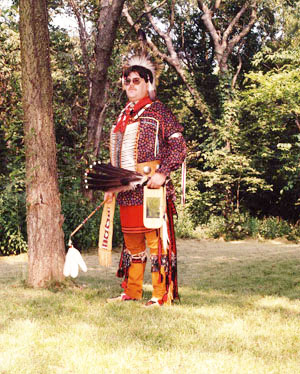
By Bruce Martin
From April 2014 issue of Delaware Indian News
Recently I have been approached by a few tribal members wondering what happened to the Lenape Gourd Dance Society. I have wondered that myself. The past few times that I have seen the Lenape Gourd Dance Society, there were only three or four members dancing. I remember back in the day there were a lot of us.
I would like this to be a call to all Lenapes who would like to revive the Lenape Gourd Dance Society. I have talked with John Sumpter, who is the Director of this Society, and offered to help him recruit past members to rejoin and to search for new members. I think as a Lenape, when we have been asked to be the Host Gourd Dance group at a dance, it would be nice to bring more than two or three dancers.
Having served on various pow-wow committees, there usually will not be a lot of money thrown at Gourd Dance groups, but we can get organized and try to do our best to represent. We are not in this to make money, but rather to dance, have a good time, and represent our heritage the best that we can.
With modern technology we should be able to communicate with each other, travel to more places and represent the Lenape Gourd Dance Society as it should be, honorably and respectfully. As John Sumpter told me, “The society was formed with the blessings of the Arapahoe Star Hawk Society back in 1995 with the efforts of Don and Betty Wilson. This blessing was given by the leader at the time, Stanly Sleeper, with the understanding that we would follow their guidelines as close as possible, but still be able to mold it to fit our group. If we get enough interest, we can get meetings started every quarter and do our initiations at the Copan dance. Don would like that. Put our beginnings in the article so that people will know that we started in a proper way and did not just get together and call ourselves a gourd dance group. Since the Delawares are not a pow-wow people and these ways are adopted by us, this will be important to know. I, myself, made several trips to El Reno to talk to Stanly and learn more about this way.
I relied on Don a lot but there were times that he said I should go talk to Stanly.” This organization is not sanctioned by the Tribe, but is a separate organization. If anyone would be interested in joining, or rejoining, please contact us with your interest or information.
John Sumpter (918) 766-5592
longwalkerlongwalk@sbcglobal.net
Bruce Martin
NMAI Historians Visit Tribal Headquarters
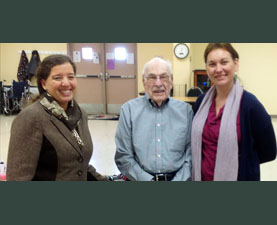
On Friday, February 21, 2014, historians and curators Gabrielle Tayac and Korah English visited the tribal headquarters in Bartlesville to get input for a new proposed exhibit at the National Museum of the American Indian (NMAI) in New York City. The exhibit, scheduled to open in 2016, is entitled “Native Nations of New York.”
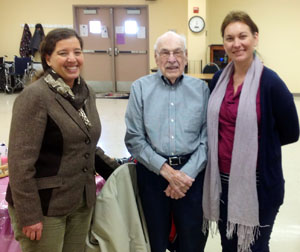 Gabrielle Tayac and Korah English at Community Center with tribal elder Lewis Ketchum. |
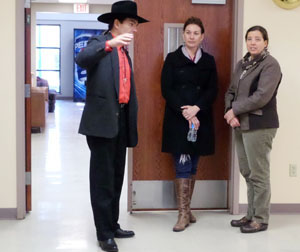 Tribal Manager Curtis Zunigha with Gabrielle and Korah. |
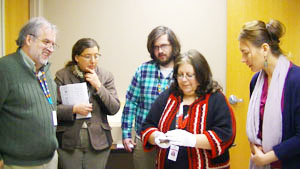 Gabrielle and Korah look at tribal artifact holdings with archaeologist Greg Brown, curatorial assistant Joe Brown, and tribal archivist Anita Mathis. |
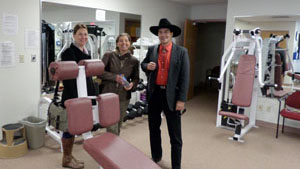 Touring the Wellness Center. |
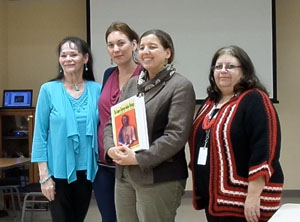 Presentation of gifts by Chief Paula Pechonick and tribal archivist Anita Mathis. |
 D5 Creation