News Item
now browsing by category
My Trip to the Gathering, by Cayla McGee
Cayla Magee
Note: this story was written by Delaware tribal member Cayla Magee, age 9, who was part of a tribal delegation attending “Maawehlahtiit” (Gathering of Our Relatives) on the Stockbridge-Munsee Reservation in Wisconsin. The delegation was led by Chief Chet Brooks and included elected leaders, elders, veterans, and youth.
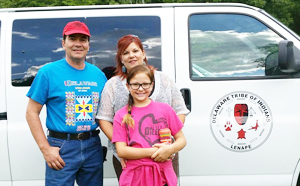
On Tuesday 7/21/15, my grandad Curtis Zunigha, Paula Pechonick, Anna Pechonick, my mom Erica Magee, and I left the tribal center at 9:30 am in a tribal van. We drove to Albert Lea, MN. Along the way, we beaded on some earrings. We also learned some Lenape words. Lenape Ni means ‘I am Lenape’ and Lenape hach ki means ‘Are you Lenape.’ That was the first time I went through 5 states in one day. We stopped and ate a wonderful dinner. We were full, we went to our hotel, the Motel 6. It wasn’t that nice of a hotel but I still had an ok time.
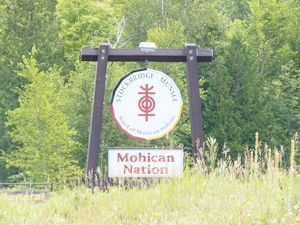
On Wednesday 7/22/15, the group and I left our hotel in Albert Lea, MN around 9:45 am, after breakfast at Perkins. We crossed the Mississippi river into Wisconsin around 11:30. It was Anna and I’s first time at the Mississippi River. There were a lot of farms with big silos and barns along the way. Finally, we arrived at the Stockbridge-Munsee Band of Mohicans reservation. We checked into the North Star Casino and Hotel around 1:00 pm. We unpacked and I immediately knew that it was going to be a great trip. After the group got changed, we all went to the powwow grounds and checked into the Gathering. We went to the hotel and it was hard to fall asleep because I was so excited for the next day!
On Thursday 7/23/15 we ate breakfast at the hotel buffet. The food was so yummy! We went to the powwow grounds and watched the color guards bring in all the flags. The Eastern communities talked about their history that morning. After lunch Anna, mom, Paula, and I set up a teaching tent. While Paula and mom displayed Lenape regalia and stomp dance cans, Anna and I went swimming in the West Branch Red River. We met one of the local girls, Lorretta, who showed us around the campgrounds. Around the arena was a road that lead to the swimming hole. Across the road was camping spots. There were over 200 people who came to the gathering. Each community sponsored a meal. That night we had Indian tacos. Our group led the evening program of social and stomp dances. My mom wore turtle shells and I wore the cans and shook a lot of the stomp dance songs. A few of my favorite social dances from that night were the Bean Dance, the Go Get ‘Em Dance and the Duck Dance.
On Friday 7/24/15 after breakfast, our group went to the grounds. The Stockbridge-Munsee and the Canadians spoke then we had lunch. We met several other kids from the reservation and even got to visit with some close friends that came from Green Bay for the Gathering. After lunch we helped work the booth. Anna and I rigged up 12 or more girls with cans during the stomp dance workshop. Mom and I got interviewed for a documentary. Anna and I helped serve supper. I tried to wear the turtle shells for the stomp dance that night, but they were too heavy, so I let my Auntie Martina wear them. At the end of the night Bruce Stonefish and his daughter showed us the stick dance. The drum was a deer hide with several long sticks around it. The men tapped it with special drum sticks and sang special songs. The songs got faster and faster. It was fun!
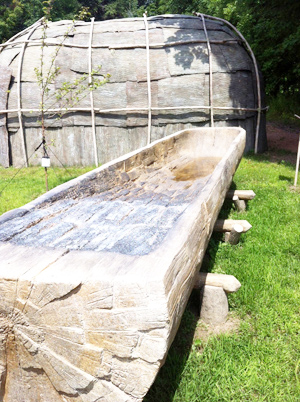
On Saturday, 7/25/15 our chief Chet Brooks talked about our history that morning. Anna and I slept in that day. My mom came back and got us and Paula before lunch. We stopped at the museum and learned about the medicine wheel, dugout canoes and a basket weaving. Each of us kids read about one of the displays. Next we went to the gift shop general store. It was owned by the tribe. We all played in the creek all day until supper.
Bonnie Jo, Kay, Martina, John, and a few other of our Oklahoma group cooked fry bread, corn soup, and grape dumplings for the big supper that night. Bella, my friend from Green Bay, and I helped serve supper.
We dressed for powwow in Delaware clothes. My grandad was proud of me. At the powwow Anna and I were recognized by the elder women. I was given a really cool pair of beaded earrings. My grandad was recognized too, by the committee.
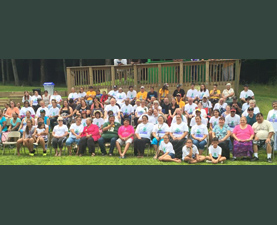
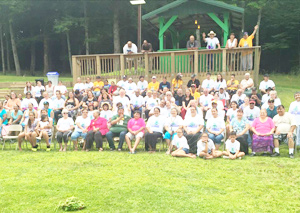
On Sunday 7/26/15 after breakfast at the casino, again we went to the grounds for a healing ceremony. Each of us took cedar in each hand and put it into the fire. One was forgiveness of self and one was forgiveness of others. We all took a big group photo. It was sad to leave, but I was excited to see my daddy and brother again.
We drove to Albert Lea MN. and stayed at the same hotel and the same restaurant!
Sunday 7/27/15 we left the motel that morning and went to go eat breakfast around 8:00 am, we crossed state lines into Iowa around 10:00 am, we crossed state lines into Missouri 2:00, Kansas 5:00, Oklahoma 8:00 I was glad I was home.
 |
 |
| Heading to the Gathering (Curtis, Erica, Cayla, and Anna) | |
 |
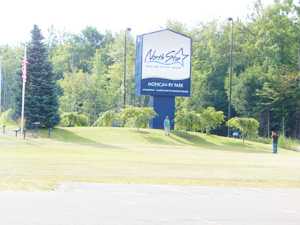 |
| Rez Casino. | |
 |
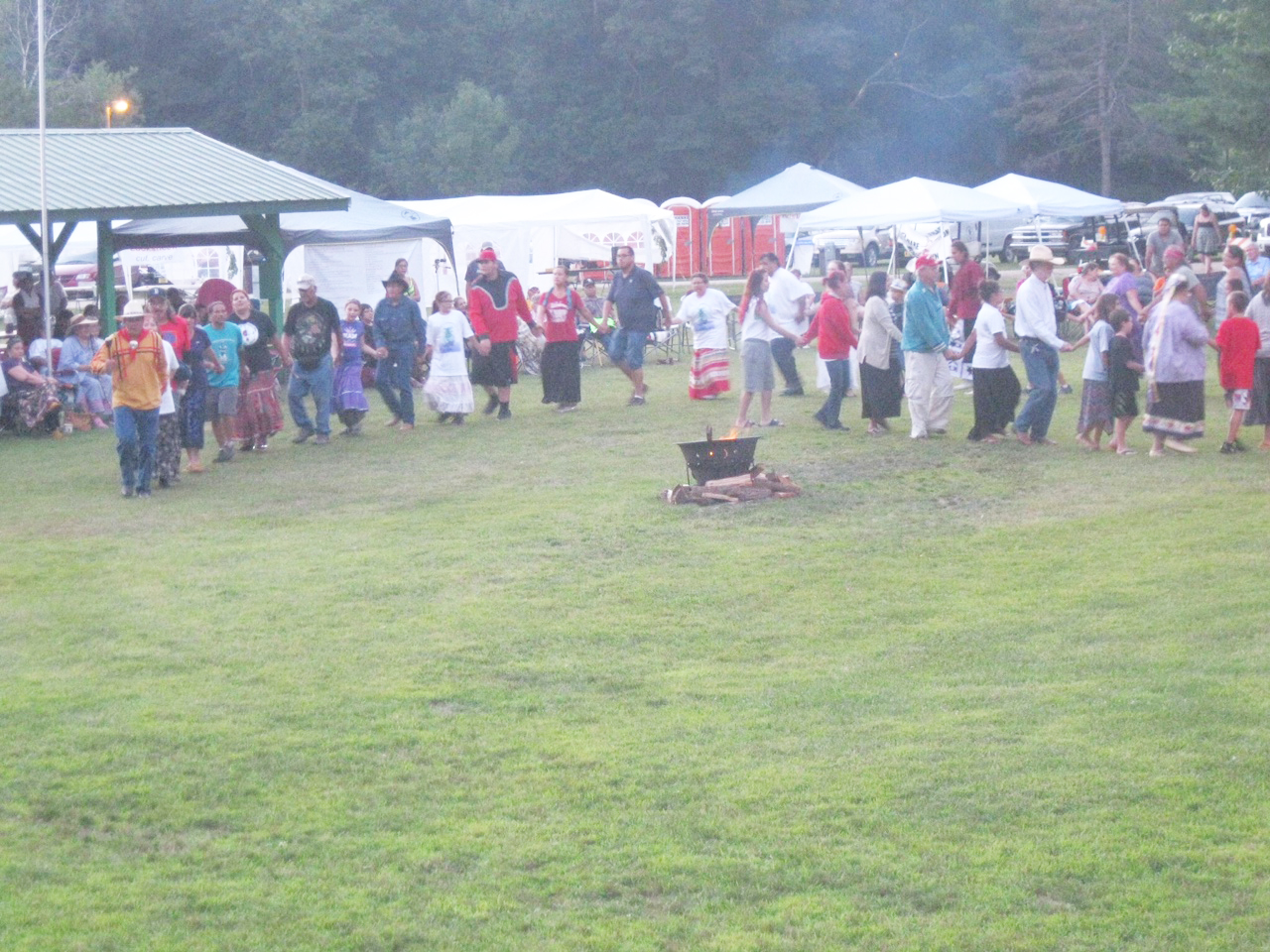 |
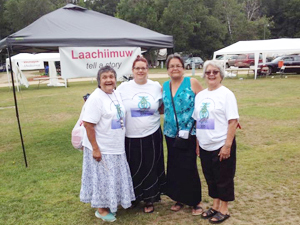
| Molly, Erica, Tammy, and Sheila; Curtis leads the Bean Dance. | |
 |
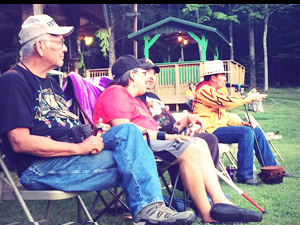 |
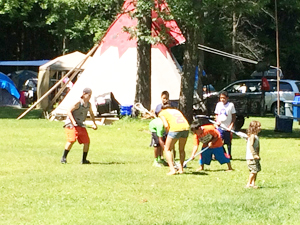
| Lacrosse game; social songs. | |
 |
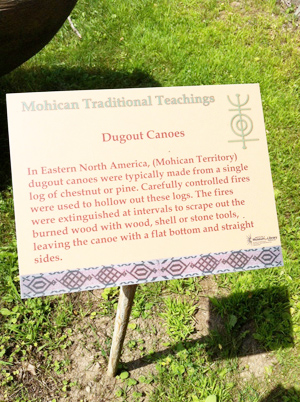 |
| Dugout canoe. | |
 |
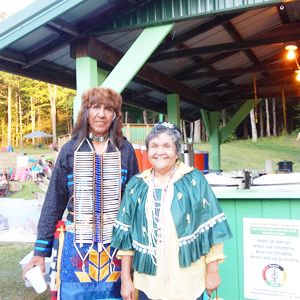 |
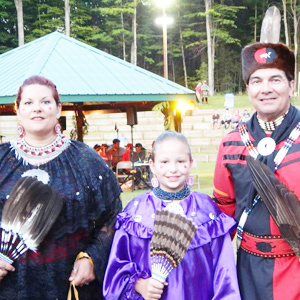
| Erica, Cayla, and Curtis; Lloyd and Molly Miller. | |
 |
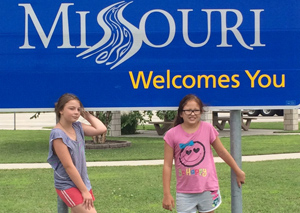 |
| Gathering group photo; finally returning home! | |
Delaware Member Receives Prestigious Fellowship
A Delaware Tribe of Indians member has been selected as a part of the inaugural class of the George Kaiser Family Foundation’s Tulsa Artist Fellowship.
According to Stanton Doyle, senior program officer at George Kaiser Family Foundation, tribal member Nathan Young, son of Delaware Tribal Council member Nate Young and Carol Chapman Young, is one of 12 artists who will comprise the Tulsa Artist Fellowship’s inaugural class.
» View Story from Bartlesville Examiner-Enterprise
Bonnie Thaxon Named AARP Honoree
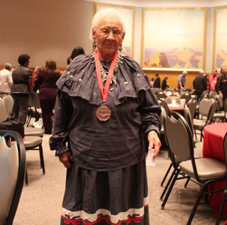
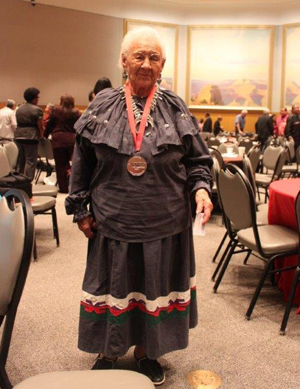
Tim Hudson
A Delaware Tribe of Indians elder is set to be honored by the AARP as a key Oklahoma-based Native American Elder.
According to a release form the AARP, Delaware Tribe of Indians Member Bonnie Thaxton has been “nominated and selected” as an honoree for the 2015 AARP Oklahoma Indian Elder Honors. The 7th annual Honor banquet will be held on October 6th at the National Cowboy and Western Heritage Museum in Oklahoma City.
“I’m 92-years-old and I’m certainly proud of my heritage with the tribe,” Bonnie said.
“And I plan to go to Oklahoma City for the ceremony.”
“This is one of AARP Oklahoma’s most prestigious and visible awards, given to recognize outstanding Native American Elders who are making a powerful difference in their communities, and Indian Country, in ways that are consistent with AARP’s mission and vision, and who inspire others to service,” said Mashell Sourjohn, Associate State Director of Community Outreach for Oklahoma AARP.
“AARP Oklahoma takes great pride in congratulating Mrs. Thaxton on all that she has done for her nation, state, community and for Indian country.”
Delaware Tribe of Indians Chief Chet Brooks says that he’s known Bonnie “at least 33 years.”
“And she is one of the Delaware Tribe’s most deserving elders to receive this AARP award and I’d like to personally thank Bonnie for all the years of service to the Delaware Tribe.”
AARP, Inc., which was formerly the American Association of Retired Persons, is a nonprofit membership and interest group, founded in 1958 for people over the age of 50. It is one of the most powerful lobbying groups in the United States.
Sourjohn says Thaxton’s record of achievement, service, and commitment to the community is “making a difference and bringing purpose to those around her.”
“She is an extraordinary exampleof the difference that can be made in the lives of individuals and in the well-being and vitality of a community,” she said.
Tim Hudson
918-815-2653
Journey of a Lifetime

Dewey resident Curt Anderson said that a visit to his ancestor’s homeland had always been in the works, but it unintentionally garnered social media attention over the summer.
» View Story from Bartlesville Examiner-Enterprise

Essay Winner: Charles Journeycake: The Faithful Chief
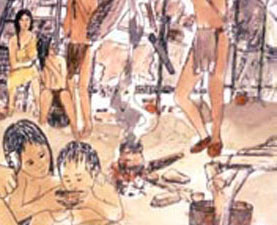
by Emily Messimore
THE DELAWARE INDIAN NEWS ANNOUNCES GRAND PRIZE WINNER
Congratulations to Emily Messimore on being the grand prize winner in the essay contest for our youth. Her essay is reprinted here.
Charles Joumeycake (Neshapanacumin) was born December 16, 1817 to Sally Williams and Delaware Chief Solomon Journeycake in Sandusky, Ohio. In 1828 the Delawares were ordered by the government to move to reservations in Kansas Territory.
After arriving in Kansas Territory, Chief Joumeycake’s mother, Sally, became a Delaware interpreter for missionaries and helped establish the first Indian Mission in Kansas. Inspired by his dedicated Christian mother, Journeycake was saved and baptized in 1833. It is thought that Journeycake was the first person to be baptized in the state of Kansas. In 1833, Charles Journeycake and his mother, Sally Williams, were the only Christians among the Delaware tribe.
In 1855, Charles Journeycake became Chief of the Wolf Clan. By 1861, Journeycake became the principal Chief of the Delaware tribe. In 1867 the Delaware people were once again removed from their homes, this time to Indian Territory, and deemed citizens of Cherokee Nation. It was at this time that Journeycake retired his title as chief, becoming the last official chief of Delaware Nation. Times were hard for the Delaware people in their new home. However, Journeycake’s faith did not waiver. He knew he had a greater purpose that was yet to be fulfilled. Chief Journeycake still cared deeply about the wellbeing and future of his tribe. Acting as chief counselor to the people, he represented the Delaware in Washington D.C. on twenty-four different occasions to fight for legal rights and economic opportunities.
This upright and loving man is largely attributed with the spread of Christianity in the Delaware tribe and in all of Indian Territory. Charles Journeycake was a disciple sent into the violent and desolate land of lndian Territory, who breathed hope into the people there. Shortly after the move to Indian Territory, Chief Journeycake organized a Church in his home. On September 23, 1872, Charles Journeycake was ordained as a minister, at the age of fifty-five, and the Delaware Baptist Church was officially founded. Seven of the eleven founding members were Journeycake’s close relatives. During Reverend Journeycake’s time preaching, the recorded members of the Delaware Baptist Church increased from eleven to nearly three hundred. Reverend Journeycake preached in several Native American languages, including Delaware, Shawnee, Wyandotte, Seneca, and Ottawa. With Journeycake’s encouragement, the Delaware Baptist Association was organized November 27, 1891. Over the course of his life, Journeycake translated the four Gospels of the Bible into the Delaware language.
Journeycake had married Jane Sosha at the age of twenty. They had ten children, eight daughters and two sons. All of their daughters became fervent Christians and worked within the Delaware Baptist Association. One of Chief Journeycake’s daughters married Mr. Bartles, the man whom Bartlesville, Oklahoma was named after.
Journeycake led his family the same way he led his tribe, with a caring dedication. Journeycake had an array of interests and accomplishments. He is credited with establishing the first trading post and post office in his hometown of Alluwe, Oklahoma.
Alluwe is actually a Delaware word that means “A better place.” Later in his life, Chief Journeycake contributed much of his time and money to the development of Bacone College in Muskogee. Chief Journeycake was an intelligent man who enjoyed reading and kept a large library in his home. However, his favorite pastimes were hunting and preaching. After his wife’s death in 1893, Journeycake found little enjoyment except in hunting and working at the Delaware Baptist Church. Charles Journeycake died on January 3, 1894. He was buried beside his loving wife in a cemetery south of Nowata. The graves were later relocated to Armstrong Cemetery in Alluwe due to the building of the Oologah dam.
Journeycake was an advocate of his people and his faith. Above all, he had a vision of what key part of history the Delaware people should hold fast to. He best summed this up in his speech before the Indian Defense Association in 1886. He said, “We have been broken up and moved six times. We have been despoiled of our property.
We thought when we moved across the Missouri River, and had paid for our homes in Kansas we were safe. But in few years the white man wanted our country. We had made good farms, built comfortable houses and’ big barns. We had schools for our children and churches where we listened to the same Gospel the white man listened to. We had a great many cattle and horses. The white man came into our country from Missouri and drove our cattle and horses away across the river. If our people followed them they got killed.
We try to forget these things, but we would not forget that the white man brought us the blessed Gospel of Christ, the Christian’s hope. This more than pays for all we have suffered.”
Sources Cited
Self, Burl. “Journeycake, Charles.” Encyclopedia of Oklahoma History and Culture, 2009. Web. 29 August 2015.
Claremore Museum of History. “Remembering: Delaware Chief, Charles Journeycake.” MoreClaremore, 16 December 2013. Web. 29 August 2015.
Lawson, Russell. “Charles Journeycake and Indian University.” The Baconian, II March 2015. Web. 30 August 2015.
Tatum, Lawrie. “Our Red Brothers and the Peace Policy of Ulysses S. Grant.” Google Books, ND. Web. 30 August 2015.
Delawares Head to Delaware Water Gap National Recreation Area
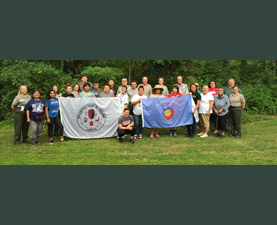
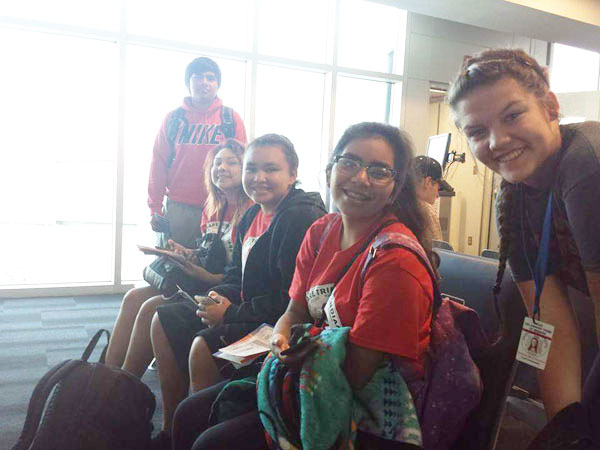
» NEWSPAPER STORY–Teens walk in ancestors footsteps at Delaware Water Gap National Recreation Area
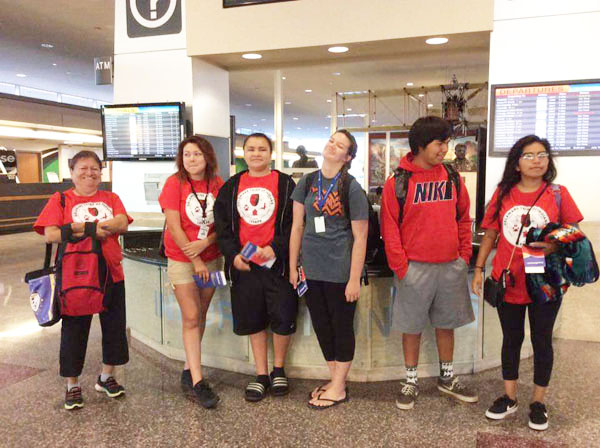 |
| Great group of Delaware youth headed out to the Delaware Water Gap National Recreation Area with their fearless Leader, Cece Runnels. (l-r) Cece, Hopie Thicknail, Kamren Pisachubbe, Kayla Provence, ShuDay Johnson Biggoose, Tiana Long. |
 |
Congratuations to Recent Graduates
 |
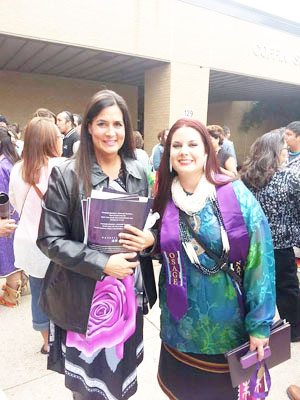 |
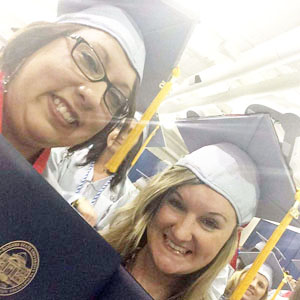
| Delaware member, Crystal Thaxton-Dombrovsky, on left. Graduating with a Nursing degree. | Maggie Gray is from our neighboring Osage Nation. Congrats on Graduating from Haskell!!! Pictured with her mother Jennifer here. |
 |
 |
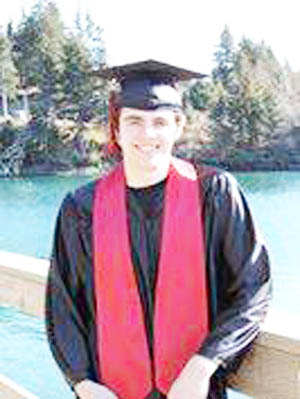
| Chance Haller, Valedictorian, Susan B. English School in Seldovia Alaska. | Congrats Delaware member Lori Hasselman, who received her AA in Media Communications at Haskell. She was also awarded Haskell Student of the Year! |
 |
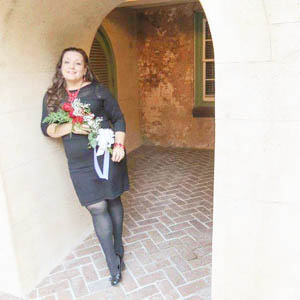 |
| Andrew Dean Humphrey 2015 Graduate of Oologah High School. | Member Myckie Jacobsen graduated from the College of Charleston with a BA in Biology with a minor in Environmental Studies. |
 |
 |
| One of our Delawares, Native Studies grad at Haskell. Congrats Bear Tompkins. | Congrats Delaware member Amy Jay Wiley graduates from the University of Miami with a degree of Bachelor of Science in Education with a major in Exercise Physiology and minor in Chemistry. Receiving her degree from President Donna Shalala. |
Lenapeowsi Foundation
“Lenapeowsi” means to live the Lenape way. The Foundation is a 501(c)3 organization with a mission to preserve, sustain, and perpetuate Lenape language, culture and society. The organization was founded by three Delaware members: John Sumpter, Titus Frenchman, and Nicky Michael. Today, this organization mainly focusses on youth activities. Each year the foundation holds a Christmas Party attended by nearly one hundred people. The Foundation provides Christmas presents to all the children who attend the party. Moreover, each Thursday evening since 2007, the Foundation holds a pot luck and cultural activity as well as language instruction at the Delaware Community Center in Bartlesville, OK. Levi Randoll (Delaware) and Jason Jones (Euchee) volunteer their time and effort to provide this Thursday night activity. Nancy Sumpter and Kay Anderson, both Delaware Elders, attend and provide for the weekly activities. They assure everyone is fed, clothed, and behaved appropriately as most Grandmothers do.
All children are welcome to attend our activities regardless of tribal affiliation. While we focus on Lenape culture, we include other Tribes as well. For instance, some of the kids know how to sing in both Kiowa and Lenape. Cherokee culture is also strongly influential in our area. Last week, the youth attended a stomp dance at the Miami Tribe complex.
The Cherokee Nation, Native Voices Rising, and the Delaware Tribe have all supported the organization with both cash grants and in-kind donations. Our youth also sell t-shirts, wrist bands, and fans to raise money for their field trips and dance attire. If you would like to donate to this organization or purchase items, please call the Chairwoman, Nicky Kay Michael, PhD at (918)766-6299, or submit a check to Lenapeowsi Foundation, 927 E. Portland Ave. Dewey, OK 74029.
The Delaware People’s Historical Presence in Pennsylvania
by Catherine Monck
THE DELAWARE INDIAN NEWS ANNOUNCES SECOND ESSAY WINNER
Congratulations to Catherine Monck, tribal member from Lexington, Kentucky on being our second winner in the essay contest for our youth. A $100 gift will be in the mail very soon to Catherine, and all other youth who sent in essays will be receiving $25 checks. Her essay is reprinted here.
Many people begin the history of the Delaware people around the same time the white settlers arrived in North America. The Delaware people were settled in the area that is now made up of the states of Delaware, New York, New Jersey, and Pennsylvania. They were considered to be one of the two most powerful Native American groups in North America. They lived in longhouses covered in grass and bark. Their language was Algonquin with three different dialects which were Munsee, Unami, and Unalactigo.
In the year 1610, Captain Samuel Argyll went into the area in which the Delaware people lived. He decided to name the area and the people that lived there “Delaware” in honor of his commanding officer, Sir Thomas West III Lord De La Warr, who was also the Provincial Governor of Virginia. This begins the unfortunate decline of the Delaware people. The white settlers were not respectable or understanding of the lifestyle that the Delawares had.
As more white settlers moved into the Delaware area, things began to change for the worse. The Delaware people had never been exposed to the idea of people owning land. They had always believed that “the Creator” owned all of the land, and they simply inhabited it. Yet, the white settlers had different ideas. In the beginning, the white settlers seemed to be relatively fair in their interactions with the Delawares in terms of land transactions. Then, the colonial government began to push for even more settlements and even more expansion. When the Delawares left their villages to go hunting or fishing, the land was viewed as abandoned and consequently taken. This is where many conflicts arose, and then became violent.
The once semi-fair economy began to spiral out of control as the white settlers gained more control. Soon the Delawares were running out of land in the original area to occupy. The colonial government consistently continued to push for more expansion. All of this led to more and more tensions and more clashes.
The last straw for the Delawares and the colonists was the 1737 Walking Purchase. A well-thought-out fraud from the beginning, the Walking Purchase was meant to determine how much land the Penn family (the family who helped settle Pennsylvania) would purchase. The agreement had been created while Thomas Penn was still the patriarch, and was then carried out by William Penn, who was Thomas’ son. The original idea was that the amount of land would be how far a man could walk in a day and a half. Each group of people had three men who would “walk” for them. The white settlers cheated though, training their men how to run for miles for many hours, cutting away underbrush along the way, having horses available to carry their supplies, and even boats to get them across rivers. When the Delawares protested the clearly unfair agreement, the Iroquois were called in. The Iroquois were happy to be involved in the finalization of the agreement, because they felt they had defeated the Delawares in the 17th century, and were pleased to have a title to the land.
After the 1737 Walking Purchase, the Delaware people slowly got pushed out and down south in the United States. The Native Americans and the white settlers could not coexist, and the white settlers had the power. The Delaware people slowly moved down, until many of them settled into what is now modern-day Oklahoma. Many of the living descendants of the Delawares live in Oklahoma and the surrounding areas.
The Delaware people had a difficult time in Pennsylvania. They were oppressed and abused. They were tricked and used by the white settlers. It is unfortunate that they were driven out of their land that they respected and held so dearly. Yet, despite all of these hardships, they still continue to live on and thrive. The culture is still in existence, and that is incredibly respectable.
Sources Cited
- http://www.easterndelawarenations.org/history.html
- http://delawarein.webs.com/delawarehistory.htm
- http://www.tolatsga.org/dela.html
 D5 Creation